The 3D Shift: Why Your Renders Look Artificial Despite Following Tutorials Perfectly
In the progression of mastering 3D graphics, many emerging artists encounter a frustrating paradox: despite replicating lighting parameters perfectly and aligning camera angles down to the millimeter according to tutorials, the final render still feels flat, sterile, and artificial. This phenomenon stems from the critical disconnect between software proficiency and artistic intuition. Below is an analytical breakdown from Lumina Academy on the three core architectural flaws that prevent digital assets from reaching professional, commercial-grade standards.
1. Cinematic Lighting: Moving from Atmospheric Illumination to Emotional Direction

Standard online tutorials focus heavily on technical placement—instructing users exactly where to position an Area light or what multiplier to input—while completely neglecting the physics and behavior of real-world light.
A seasoned digital artist does not merely illuminate an asset to ensure visibility. Instead, they manipulate the sharpness or softness of shadow falloffs, the psychological contrast of color temperatures, and the intentional placement of negative spaces (Shadows) to construct depth. In high-end 3D production, lighting serves as a visual conductor designed to guide the viewer’s eye and evoke specific emotional responses within the frame.
2. Advanced Composition: Visual Balance Over Arbitrary Placement
Placing subjects directly in the center of a canvas without structural calculation is a common error that renders an entire composition disjointed and uninspired.
Composition is far more than filling empty coordinates. True digital artists must master structural frameworks, including the Rule of Thirds, leading visual lines, and the geometric counter-balance between primary and secondary assets. When these visual elements are strategically orchestrated, a 3D frame transforms into a visual symphony where every asset serves a definitive purpose in elevating the primary subject.
3. Visual Storytelling: The Imperfection of Reality and the Soul of Assets
Paradoxically, absolute perfection within a digital engine is the primary reason a render looks artificial. An immaculate environment, a metallic surface devoid of blemishes, or a asset without microscopic wear immediately signals a lack of authenticity to the human eye.
A digital asset only captures genuine realism when it bears the passage of time and an underlying narrative. This is achieved through subtle imperfections: an organic scratch on a wooden grain, a fine layer of dust accumulating in a structural corner, or a porcelain cup radiating faint condensation—details that indirectly narrate human interaction. Visual storytelling is the definitive element that separates a sterile 3D model from a profound piece of digital art.
Transforming the Educational Paradigm: Stop Memorizing Toolsets, Start Cultivating Critical Observation
To accelerate advancement within the global 3D industry, creators must transcend the dependency on automated plugins or pre-configured software templates, pivoting instead toward the cultivation of distinct artistic taste.
At Lumina Academy, the educational philosophy rejects mechanical software instruction. The institution prioritizes developing critical observation skills and refining each student's artistic eye through rigorous, production-driven assignments directed by industry-leading mentors. This structural foundation is vital for aspiring talent aiming to construct an elite portfolio and secure a sustainable competitive advantage in the modern employment landscape.
Artists and digital graphics students looking to standardize their 3D mindset are invited to connect directly with the Lumina Academy admissions department for an individualized consultation on our advanced educational pathways.
Contact Information – Lumina Academy:
Official Website: www.lumina.edu.vn
Facebook Page: facebook.com/lumina.edu.vn
Hanoi Hotline: 0988 998 169 | Ho Chi Minh City Hotline: 098 85 80 869
Campus Locations:
Hanoi: 219 Trung Kinh, Cau Giay District.
Ho Chi Minh City: Dashaus Building, 27 AB Tran Nhat Duat, Tan Dinh Ward, District 1.






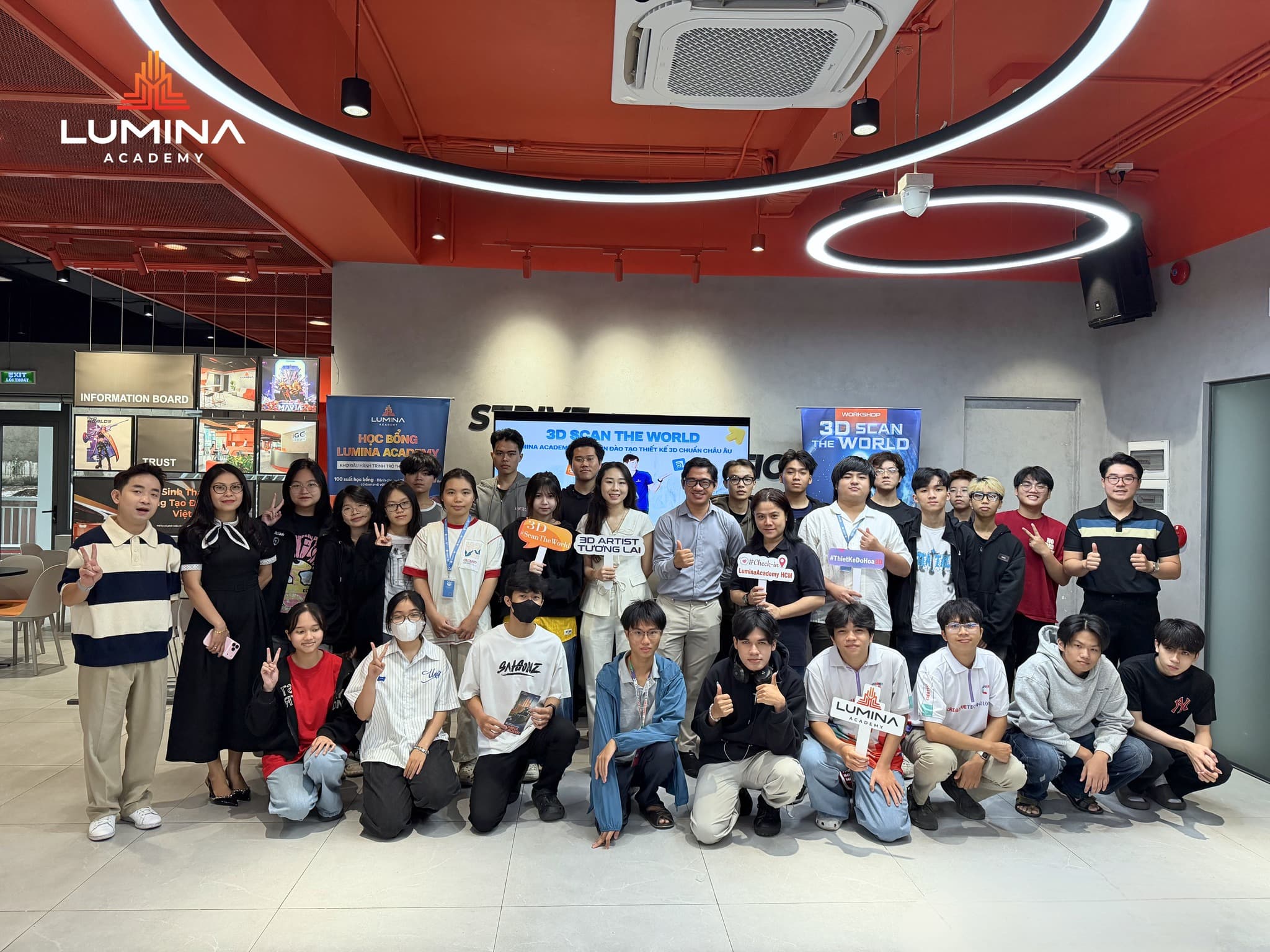

Lumina Academy


